How a DSP Campaign Doubled my "Organic" Installs Overnight
Testing a DSP to diversify beyond Google, Facebook, and Apple Ads — and what happened to organic downloads the next day.
Last year, I tested a DSP in one of the markets I manage in an attempt to diversify our acquisition channels beyond Google, Facebook, and Apple Ads.
Following the launch of our first Android campaign, we saw organic downloads almost double overnight, but this was a short-lived spike 📈.
When we increased our daily ad spend, organic installs climbed again in line with that.
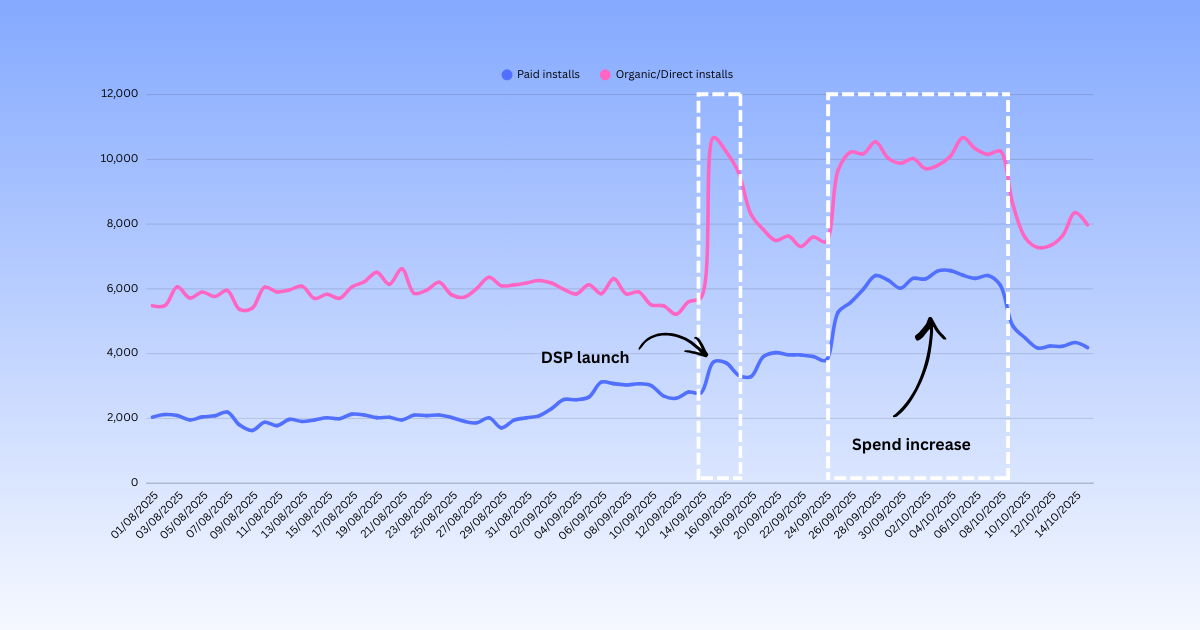
What’s happening?
I suspect that the high volume of impressions likely created strong brand recall.
Users didn’t always click the ads immediately, but when they later decided to download the app, they searched for us directly in the app store.
These installs showed up as “organic” downloads in attribution reports. In reality, they were very likely brand-assisted conversions driven by paid exposure.
This is something that often happens with high-impression channels like:
- DSP
- Display
- YouTube
- Awareness campaigns
The user journey is rarely linear. Instead of clicking the ad right away, people might simply remember the brand and come back later when the intent to download is stronger.
The effective CPI was great, just in case you were wondering 😉🫰
My takeaway
Click-through attribution massively undervalues high-impression campaigns, and as marketers, we probably need to take a more holistic view of performance and invest more in measurement frameworks that capture incrementality, not just last-click conversions.
Things like:
- Incrementality tests
- Geo holdout experiments
- Media mix modelling (MMM)
None of these are perfect, but they help reveal the true contribution of channels that influence demand, even when they don’t capture the final click.